
Does Parity Pricing Increase Sales?
Short answer: yes. Parity pricing consistently increases sales and total revenue for digital products and SaaS businesses. The data from companies of all sizes—from solo course creators to OpenAI—tells the same story.

The Evidence: Yes, It Works
Across every category of digital product—SaaS, online courses, streaming, games, AI tools—the pattern is the same: adjusting prices to local purchasing power increases total revenue. See our parity pricing examples for 15+ companies doing this with actual price comparisons.
Not because you're charging more. Because you're converting customers who were previously priced out entirely. A customer paying $30 instead of $0 is pure incremental revenue.
Companies implementing localized pricing see approximately 30% higher growth rates compared to those that don't (ScaleMath). For background on what purchasing power parity pricing is and why your online business needs it, we covered those in depth already.
The Economics: Why It Works
Price Elasticity in Emerging Markets
Price elasticity measures how much demand changes when you change the price. In emerging markets, demand for digital products is highly elastic—small price reductions produce large increases in purchases.
Consider a $99 SaaS tool. In the US, where median household income exceeds $70,000, that's pocket change. In India, where median income is roughly $2,500, it's nearly 4% of annual earnings—the equivalent of an American paying $2,800. At that price, demand is essentially zero.
Drop the price to $29 for India (a 70% discount), and suddenly it's affordable. The marginal cost of serving a digital product to one more customer is near zero, so every sale at any price above $0 is profitable. This is why digital products are uniquely suited to parity pricing—unlike physical goods, there's no per-unit manufacturing or shipping cost eating into margins.
The World Bank's PPP data shows that purchasing power varies by 5-10x across countries. A one-size-fits-all price ignores this reality and leaves enormous demand unserved.
Case Studies With Real Numbers
1. Dave Foy: 30% Revenue From PPP Sales
Dave Foy, an online course creator and web designer, reported that 30% of his revenue came from parity-priced purchases. The key detail: every one of those sales came from countries where he'd never made a single sale in eight years of selling courses online.
Before PPP, his audience was exclusively from the US, UK, Australia, and Canada. After enabling it, he gained students from Nigeria, Thailand, Colombia, and dozens of other countries. This wasn't cannibalization of existing sales—it was pure net-new revenue.
2. OpenAI ChatGPT Go: Subscribers Doubled in India
When OpenAI launched ChatGPT Go in India for INR 399/month (~$4.50, compared to $20/month in the US), paid subscribers more than doubled within a month (OpenAI). ChatGPT head Nick Turley announced the result directly.
The plan has since expanded to 16+ countries across Asia, confirming that the India results weren't a fluke. OpenAI priced ChatGPT Go at roughly 77% below the US price, and the subscriber volume more than compensated.
3. Steam: 43% of Revenue From Emerging Markets
Valve's Steam platform is perhaps the longest-running success story in regional pricing. Games are priced up to 70% lower in emerging markets, and the results speak for themselves:
- 43% of purchases now originate from emerging markets (Regional Price Calculator)
- Asia-Pacific accounts for 42% of Steam's total user base
- Brazil alone saw 41% growth in Steam users in a single year
- Developers using regional pricing see 200-400% higher revenue from international markets compared to flat pricing
Regions outside North America and Western Europe now account for over 60% of total Steam revenue. Without regional pricing, most of that revenue wouldn't exist.
4. Netflix: From US-Centric to 190 Countries
Netflix uses aggressive regional pricing, with ARPU (average revenue per user) ranging from $17.26 in the US to $7.34 in Asia-Pacific (DemandSage). The lower prices aren't a loss—they're a strategy:
- By 2021, over 90% of new subscribers came from outside the US and Canada
- Asia-Pacific subscriptions are forecast to grow from 16.2M (2019) to 70.1M by 2029
- EMEA reached 101 million subscribers in 2024
- The $2-3/month mobile-only plan in markets like India and Pakistan drives volume that flat US pricing never could
5. Spotify: 73% of New Subscribers From Emerging Markets
Spotify Premium costs $12.99/month in the US but as low as $1.59/month in India. The result: Latin America, Asia, Africa, and Oceania accounted for 73% of all new subscribers, with a 130% year-over-year increase in those regions. These markets are projected to represent over 70% of all global streaming growth through 2027.
The Math: A Worked Example
Let's walk through a hypothetical for a $99 SaaS product.
Without Parity Pricing
Assume 10,000 monthly visitors, of which 40% are international (this is typical for English-language digital products):
- 6,000 US/Western visitors × 2% conversion = 120 sales
- 4,000 international visitors × 2% conversion = 80 sales
- Total: 200 sales × $99 = $19,800/month
But that 2% international conversion rate is optimistic. In reality, visitors from countries where $99 represents a week or more of income mostly bounce. A more realistic international conversion rate without PPP is closer to 0.5%.
- 6,000 US × 2% = 120 sales × $99 = $11,880
- 4,000 international × 0.5% = 20 sales × $99 = $1,980
- Total: 140 sales = $13,860/month
With Parity Pricing
Now enable PPP with an average 50% discount for international visitors:
- 6,000 US × 2% = 120 sales × $99 = $11,880 (unchanged)
- 4,000 international × 1.5% = 60 sales × $49.50 = $2,970
- Total: 180 sales = $14,850/month
The Difference
| Metric | Without PPP | With PPP | Change |
|---|---|---|---|
| US Revenue | $11,880 | $11,880 | $0 |
| International Revenue | $1,980 | $2,970 | +$990 |
| Total Revenue | $13,860 | $14,850 | +$990 (+7.1%) |
| Total Customers | 140 | 180 | +40 (+28.6%) |
That's $990 more per month ($11,880/year) with zero additional marketing spend, and 40 more customers who can leave reviews, refer others, and upgrade later. And this is a conservative example—Dave Foy saw 30% of total revenue from PPP, and OpenAI doubled subscribers in a single market.
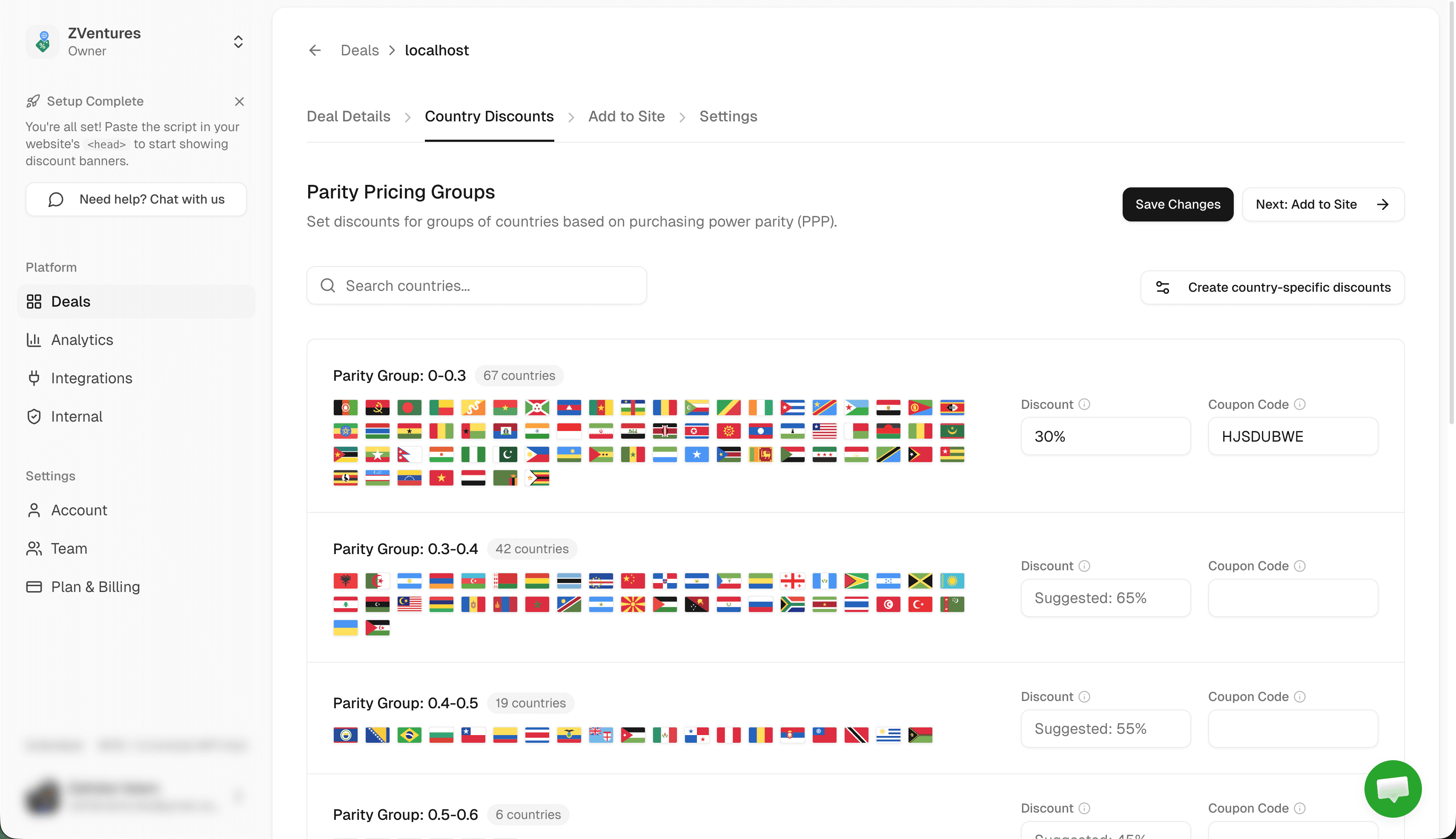
As your international traffic grows (and it will, especially with SEO), the PPP revenue compounds. At 60% international traffic, the same math yields an even larger gap.
Potential Downsides and How to Mitigate Them
VPN Abuse
The most common concern: customers in high-income countries using VPNs to get lower prices.
In practice, the abuse rate is typically under 5%. The revenue from legitimate customers in lower-income countries far outweighs the small losses from VPN users. Modern PPP tools like Evendeals include VPN detection to minimize this further.
I'd rather help the 95% of people who genuinely need it than worry about the 5% who might cheat. — Dave Foy
Perceived Unfairness
Some customers in higher-income countries may feel it's unfair. The reframe: you're not charging different prices for the same product—you're making the product equally affordable relative to local income. A developer in Germany paying $99 and a developer in Nigeria paying $29 are both spending a comparable share of their monthly income.
Transparency helps. Show the discount banner openly with a message like “We noticed you're visiting from [country]. Here's a discount adjusted for your local purchasing power.” Most people appreciate the inclusivity.
Revenue Cannibalization
Will people who would have paid full price get the discount instead? Minimal risk, because:
- Discounts only apply to visitors from lower-income countries—US and Western European visitors see full price
- VPN detection catches most attempts to game location
- Auto-refresh rotating codes prevent discount sharing
How to Measure Impact
Don't just turn on PPP and hope. Measure it deliberately:
1. Track Country-Level Metrics
Before enabling PPP, record your baseline: conversion rate, revenue, and customer count by country. After enabling it, compare the same metrics. Evendeals includes a built-in analytics dashboard with country-level conversion tracking for exactly this purpose.
2. Monitor for Cannibalization
Watch your US/Western conversion rates and revenue. If they stay flat (they should), any international revenue is pure upside.
3. Calculate True ROI
True PPP ROI = (New international revenue) − (Lost revenue from VPN abuse) − (Cost of PPP tool). For most businesses, this is strongly positive from month one.
4. A/B Test Discount Levels
Not all discounts perform equally. A 40% discount in Brazil might convert better than 60%. Test different discount tiers per country group and optimize based on data, not guesswork.
Get Started
The evidence is clear: parity pricing increases sales for digital products across every category and company size. The only question is how much revenue you're currently leaving on the table.
For a detailed walkthrough, read our Country-Based Pricing Guide. If you want to understand the broader business case first, see Why Your Online Business Needs Parity Pricing.
Evendeals makes implementing PPP pricing as simple as adding one line of code. Free plan includes up to 1,000 monthly pageviews—enough to test the impact before committing.
Try Evendeals Free