
What is Purchasing Power Parity Pricing?
A complete guide to PPP — the economic concept, the Big Mac Index, and how companies like Netflix, Spotify, and OpenAI use it to price globally.
What is Purchasing Power Parity (PPP)?
Purchasing Power Parity is an economic theory that compares different countries' currencies through a "basket of goods" approach. The core idea is straightforward: in the absence of transaction costs and trade barriers, identical goods should cost the same in every country when prices are expressed in a common currency.
The concept was first formulated by the Swedish economist Gustav Cassel in 1918, though the underlying idea dates back centuries. Today, institutions like the International Monetary Fund (IMF) and the World Bank use PPP to compare economic output and living standards across countries.
In practical terms, a PPP conversion factor tells you how many units of a local currency you need to buy what one US dollar buys in the United States. If a haircut costs $20 in New York and ₹200 in Mumbai, the PPP conversion factor between the two is 10 rupees per dollar — even if the market exchange rate is 83 rupees per dollar.
PPP vs. Market Exchange Rates
Market exchange rates are driven by financial flows, speculation, interest rates, and central bank policies. They fluctuate constantly and often don't reflect real differences in cost of living. PPP rates, on the other hand, are based on what money can actually buy in each country.
This distinction matters for two reasons:
- Comparing economies: Using market exchange rates, India's GDP is roughly $3.9 trillion. Using PPP, it jumps to over $14 trillion — making it the third-largest economy in the world. The IMF's World Economic Outlook regularly publishes both measures.
- Pricing products: If you charge $100 for a course in the US and convert that at the market exchange rate for India, you get roughly ₹8,300. But the average Indian earner would need to work significantly longer to afford that than an American buying the same product at $100. PPP tells you the "fair" local price.
| Measure | Based On | Good For |
|---|---|---|
| Market Exchange Rate | Currency trading, capital flows | International trade, forex |
| PPP Exchange Rate | Price of a basket of goods | Comparing living standards, pricing products fairly |
The Big Mac Index — PPP Made Simple
The Big Mac Index was invented by The Economist in 1986 as a lighthearted way to test PPP theory. Since a Big Mac is made to a virtually identical recipe in about 70 countries, it works as a single-item "basket of goods."
The logic: if PPP holds, a Big Mac should cost the same everywhere once you convert currencies. When it doesn't, the difference signals whether a currency is overvalued or undervalued against the dollar.
2026 Big Mac Prices (Selected Countries)
| Country | Big Mac Price (USD) | vs. US ($6.15) |
|---|---|---|
| Switzerland | $9.12 | +48% (overvalued) |
| Uruguay | $8.75 | +43% (overvalued) |
| Norway | $7.51 | +23% (overvalued) |
| United Kingdom | $7.05 | +15% (overvalued) |
| United States | $6.15 | Baseline |
| Malaysia | $3.00 | −51% (undervalued) |
| India | $2.62 | −57% (undervalued) |
| Indonesia | $2.54 | −59% (undervalued) |
| Taiwan | $2.38 | −61% (undervalued) |
Source: Statista / The Economist Big Mac Index, bigmacindex.app
A Big Mac in India costs 57% less than in the US. That gap mirrors the broader difference in purchasing power between the two countries. The same logic applies to digital products — if your SaaS costs $20/month, the "PPP-adjusted" price in India might be around $8–9/month.
World Bank PPP Data & Statistics
The World Bank's International Comparison Program (ICP) produces the most comprehensive PPP data available. It surveys prices of thousands of goods and services across 176 economies to compute PPP conversion factors.
Key findings from the latest data:
- Global GDP per capita (PPP) was $24,248 in 2024 — but this average masks enormous variation.
- The US had a GDP per capita (PPP) of roughly $85,000, while India's was about $10,000 — an 8.5x gap.
- China's GDP per capita (PPP) reached $27,105 in 2024, indicating that while China's economy is massive in aggregate, individual purchasing power is still far below wealthy nations.
- The IMF's PPP implied conversion rates are updated in each World Economic Outlook and are freely accessible.
This data is why economists prefer PPP for cross-country comparisons of living standards — and why businesses should use it to set fair international prices.
PPP Pricing for Digital Products
Digital products — SaaS, online courses, ebooks, memberships — have near-zero marginal cost. Serving a customer in Nigeria costs the same as serving one in Norway. This makes digital products ideal candidates for PPP pricing because lowering the price for a lower-income market doesn't meaningfully increase your costs, but it can dramatically increase your customer base.
When a business applies PPP to its pricing, it typically means:
- Detecting the visitor's country (via IP geolocation)
- Looking up that country's PPP factor relative to a base country (usually the US)
- Offering an adjusted price or a discount coupon that reflects local purchasing power
This is sometimes called parity pricing, regional pricing, or geo-pricing. The goal is the same: make the product equally affordable everywhere.
For a deeper look at the business case, read why your online business needs parity pricing. Want hard numbers? See does parity pricing increase sales.
Real-World Examples
Some of the world's biggest companies already use PPP-based pricing. For a comprehensive breakdown, see our parity pricing examples post with 15+ companies and actual price comparisons.
OpenAI — ChatGPT Go
OpenAI launched ChatGPT Go in India at ₹399/month (~$4.57), compared to ChatGPT Plus at $20/month in the US — a 77% discount. The plan offers expanded GPT-5 access, higher message limits, and image generation. OpenAI later offered it free for a year to Indian users during a promotional window — a clear bet on long-term market share in a price-sensitive region.
Netflix
Netflix charges $15.49/month (Standard) in the US but as low as $2.82/month in Pakistan and $6.48/month in Turkey. In Switzerland, it costs $21.48/month. These prices track closely with each country's PPP factor. A VPNPro study found Netflix is 50x more expensive as a share of GDP per capita in Zimbabwe than in Qatar — showing that even with regional pricing, there's room for improvement.
Spotify
Spotify Premium is $12.99/month in the US and approximately $1.59/month in India. Both Denmark and Switzerland pay the highest rates globally, while India consistently has the lowest. Spotify's regional pricing has helped it reach over 250 million paid subscribers worldwide.
Steam
Valve's Steam platform pioneered PPP pricing in gaming. When developers set a base USD price on Steamworks, Steam recommends adjusted prices for every other region based on PPP data. Games in markets like Brazil, Turkey, and Argentina can be priced up to 70% lower than in the US. Most indie developers follow Steam's recommendations, while larger publishers sometimes deviate.
Adobe
Adobe Creative Cloud All Apps is $54.99/month in the US but approximately $7.20/month in Turkey — an 87% difference. Adobe also offers steeper student discounts in emerging markets, effectively layering PPP on top of segment-based pricing.
How to Implement PPP Pricing
You don't need to be Netflix-sized to use PPP pricing. The basic steps are:
- Detect visitor location using IP geolocation.
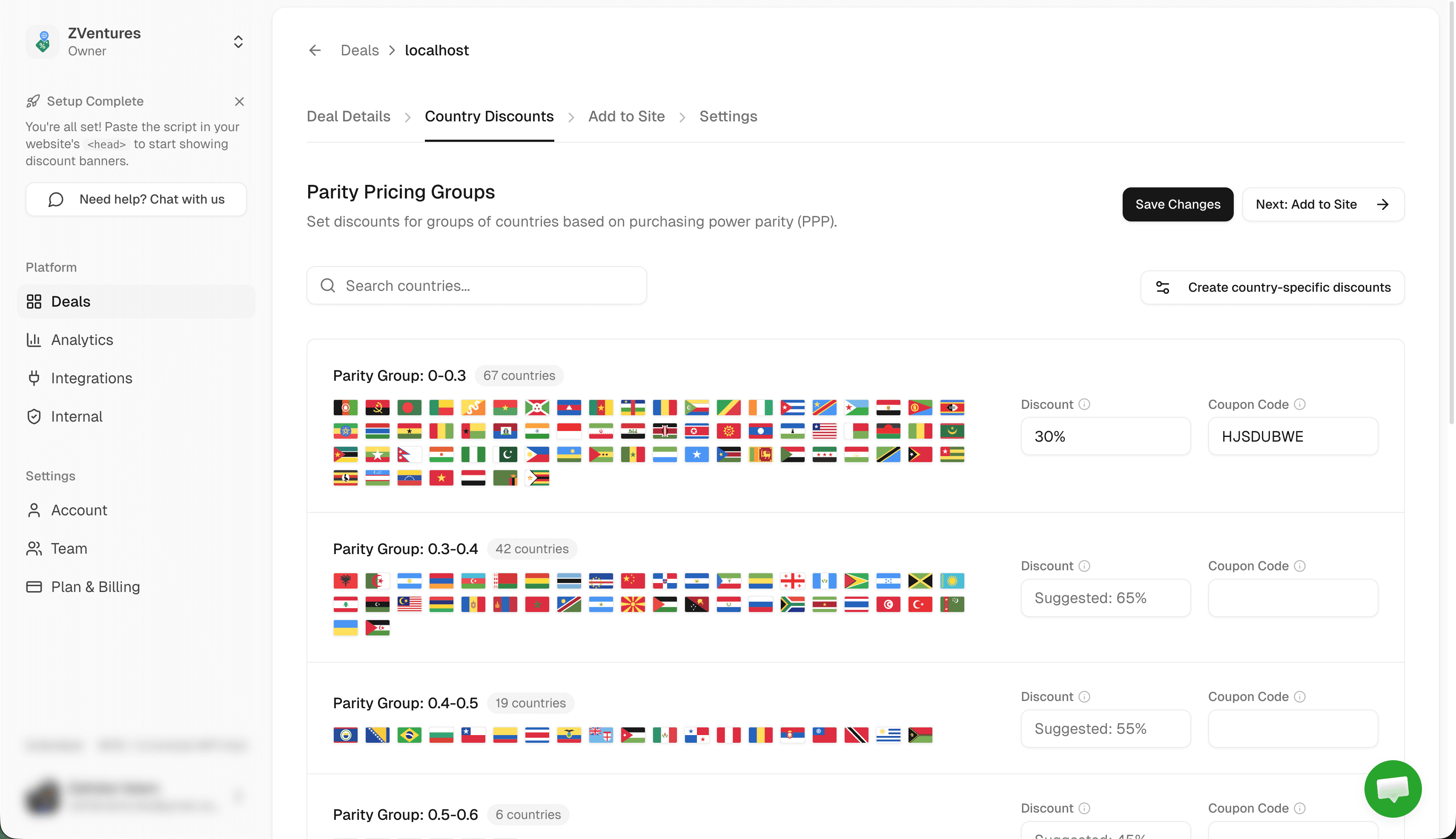
- Group countries into tiers based on purchasing power (e.g., Tier 1: US, UK, Germany; Tier 2: Brazil, Mexico; Tier 3: India, Nigeria).
- Set discount percentages for each tier reflecting the PPP gap.
- Display adjusted prices via a banner or inline on your pricing page.
- Create coupon codes in your payment provider (Stripe, Lemon Squeezy, Dodo Payments, Creem, etc.) that match each tier.
For a detailed walkthrough, see Country-Based Pricing: The Ultimate Guide.
Or skip the DIY approach entirely — tools like Evendeals handle geolocation, discount banners, coupon syncing, VPN detection, and analytics out of the box. Free to start with 1,000 monthly pageviews. Building a custom integration? See our Purchasing Power Parity API guide.
Conclusion
Purchasing Power Parity is more than an economics textbook concept — it's a practical framework for pricing products in a global market. The Big Mac Index makes it intuitive, World Bank data makes it rigorous, and companies like Netflix, Spotify, Steam, and OpenAI prove it works at scale.
For digital product sellers, PPP pricing is one of the highest-ROI changes you can make. You're not lowering your prices — you're right-sizing them for each market. The result: more customers, more revenue, and a genuinely global business.
Next steps:
- Why your business needs parity pricing — the revenue case
- Country-based pricing guide — step-by-step setup
- ChatGPT Go in India — case study