
ParityDeals Pricing in 2026: Plans, Costs, and What You Get
A full breakdown of ParityDeals' three pricing tiers: what's included, what's not, what it costs annually, and how it compares to alternatives.
ParityDeals is one of the more established parity pricing tools on the market. It detects where your visitors are coming from and shows them location-based discounts so they can afford your product. If you're evaluating it, the first question is usually: what does it actually cost?
Here's a transparent breakdown of every plan, what's included, and what you'll realistically spend.
What ParityDeals Does
ParityDeals adds purchasing power parity (PPP) pricing to your website. It works by detecting visitor location via IP, then showing a discount banner or coupon code adjusted to that country's purchasing power. It integrates with payment providers like Stripe, Lemon Squeezy, Gumroad, and Paddle to auto-create coupon codes at checkout.
The core use case: you sell a $99 course or SaaS subscription, and a visitor from India or Brazil sees a 40-60% discount banner. They click through, the coupon applies automatically, and you capture a sale you would have otherwise lost.
ParityDeals Pricing Plans (2026)
ParityDeals offers three public plans plus a custom tier for high-volume users. Plans are billed monthly, with a yearly option that saves 20%.
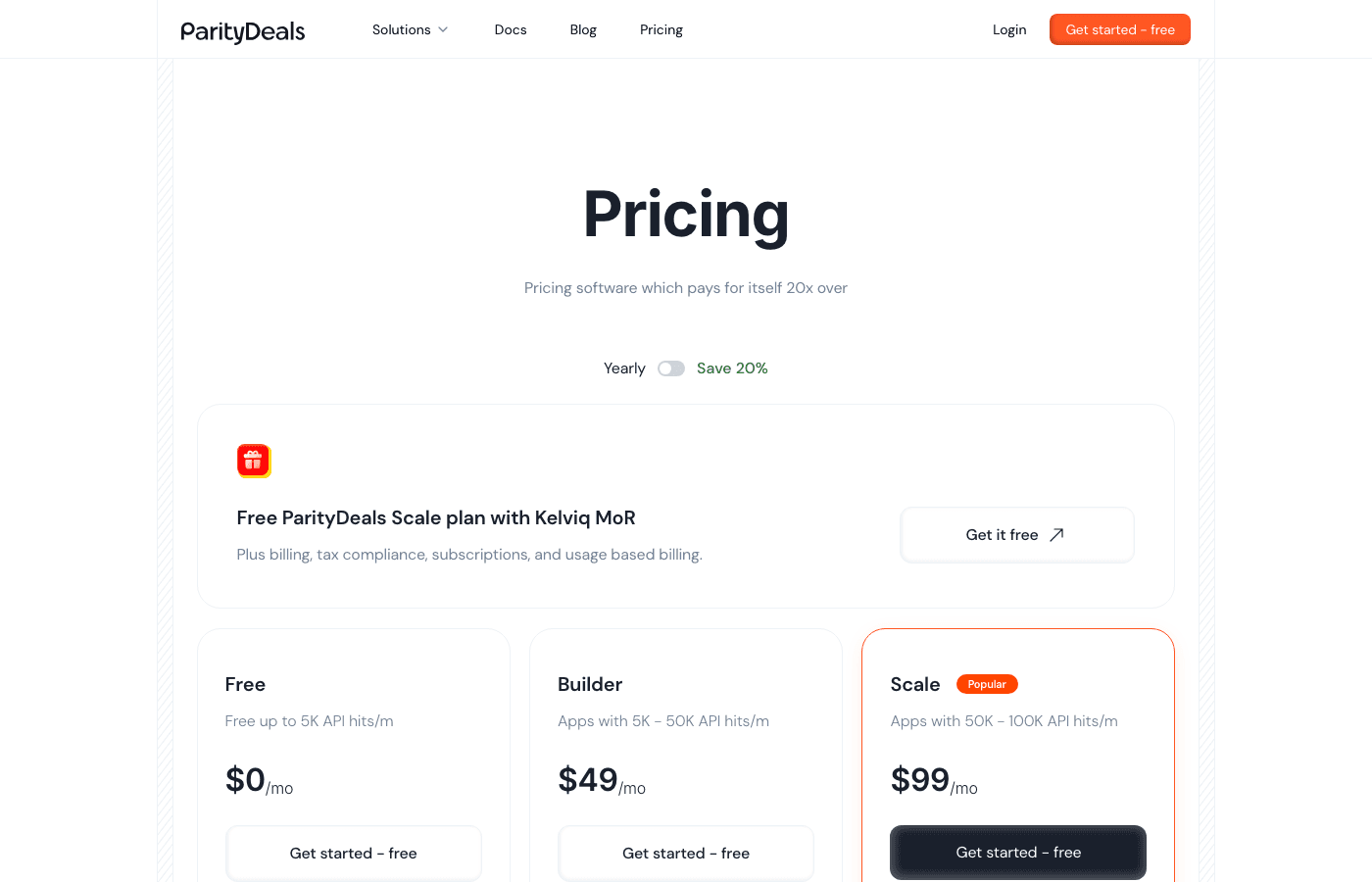
Free Plan — $0/month
- Up to 5,000 API hits/month
- 1 product
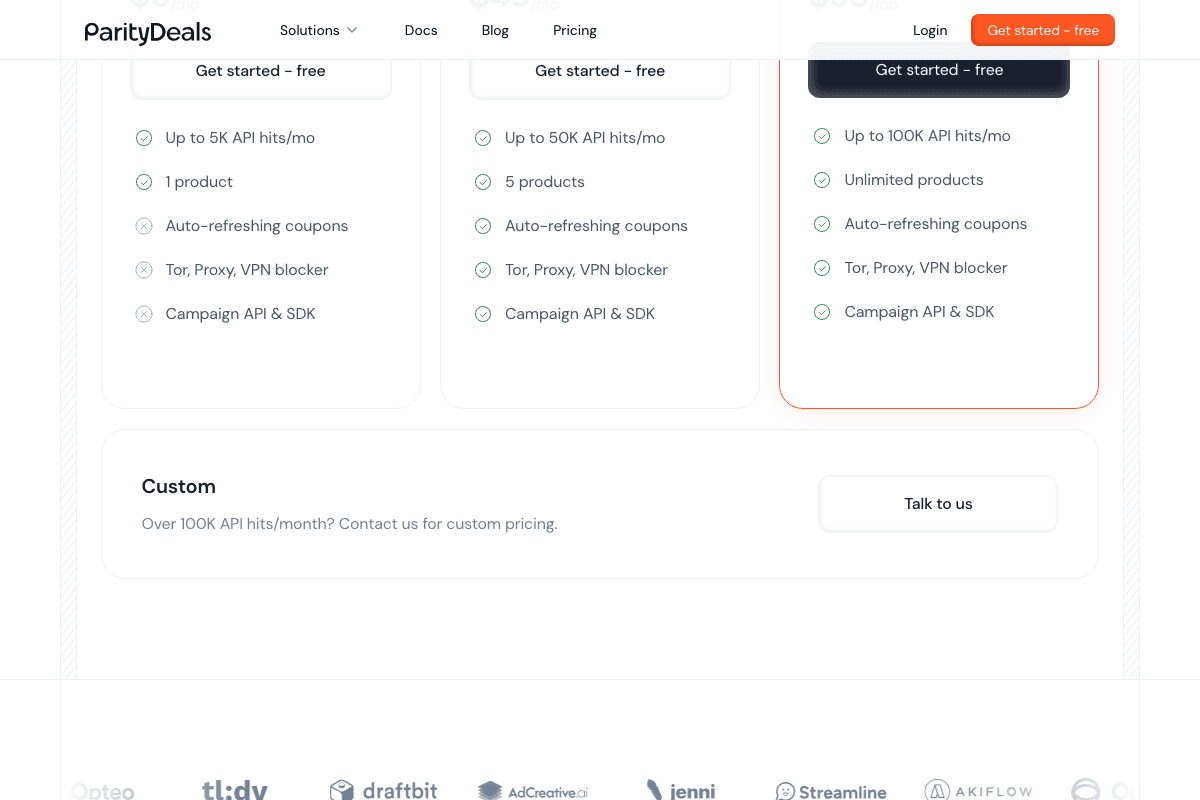
- No auto-refreshing coupons
- No VPN/proxy/Tor blocking
- No Campaign API or SDK access
The free plan is genuinely useful for testing. You can set up a banner on a single product and see if parity pricing moves the needle before committing. The 5K hit limit is enough for most small sites — if you get under ~150 unique visitors/day, you probably won't hit it.
The catch: no auto-refreshing coupons means users can share discount codes, and no VPN blocking means someone in the US could use a VPN to get the Indian price. For a test, that's fine. For production, it's a problem.
Builder Plan — $49/month
- Up to 50,000 API hits/month
- 5 products
- Auto-refreshing coupons
- VPN/proxy/Tor blocking
- Campaign API & SDK
This is where ParityDeals becomes production-ready. Auto-refreshing coupons rotate codes so they can't be shared on coupon sites. VPN blocking prevents location spoofing. The Campaign API lets you trigger discounts programmatically — useful if you want to combine parity pricing with holiday promotions.
The 5-product limit is worth noting. If you sell a course bundle, a SaaS subscription, and a few digital downloads, you could hit that ceiling quickly.
Annual cost: $49 × 12 = $588/year (or ~$470/year with the yearly discount).
Scale Plan — $99/month
- Up to 100,000 API hits/month
- Unlimited products
- All Builder features included
- Campaign API & SDK
Same features as Builder, but with unlimited products and double the API hits. This is the plan for businesses with multiple products or higher traffic.
Annual cost: $99 × 12 = $1,188/year (or ~$950/year with the yearly discount).
Custom — Contact Sales
For sites that exceed 100K API hits/month. No public pricing — you'll need to reach out directly.
What You'll Actually Pay
Monthly pricing adds up. Here's what each plan costs over time:
| Plan | Monthly | Year 1 | Year 2 | Year 3 |
|---|---|---|---|---|
| Free | $0 | $0 | $0 | $0 |
| Builder | $49 | $588 | $1,176 | $1,764 |
| Scale | $99 | $1,188 | $2,376 | $3,564 |
With yearly billing (20% off), the Builder plan comes to ~$470/year and Scale to ~$950/year. That's a meaningful discount if you're committed.
Which Plan Do You Actually Need?
Stick with Free if:
- You're testing whether parity pricing works for your audience
- You have a single product and low traffic (<150 visitors/day)
- You don't mind the coupon-sharing risk during testing
Go Builder if:
- You need VPN protection and auto-refreshing coupons (most production sites do)
- You have 5 or fewer products
- You want API/SDK access for custom implementations
Go Scale if:
- You have more than 5 products
- Your site gets 50K+ monthly visitors and you're hitting the Builder API limit
Most solo founders and small teams will land on the Builder plan. The jump from Free to Builder is where the real value is — VPN protection alone prevents significant discount abuse.
What's Not Included
A few things worth knowing before you commit:
- No countdown timers — There's no built-in urgency mechanic. If you want "this discount expires in 2 hours" timers, you'd need to build that yourself.
- API hit limits are hard — If you exceed your plan's API hits, the banner stops showing. There's no overage billing; you upgrade or lose coverage for the rest of the month.
How ParityDeals Pricing Compares
ParityDeals isn't the only option. The main difference between parity pricing tools comes down to the pricing model itself: recurring monthly fees vs one-time payments.
For context, Evendeals (disclosure: our product) offers comparable features — PPP banners, VPN detection, auto-refreshing coupons, Stripe + Lemon Squeezy + Dodo Payments + Creem + Polar + WooCommerce + FastSpring integrations — but charges a one-time fee instead of monthly.
| ParityDeals (Scale) | Evendeals (Pro) | |
|---|---|---|
| Pricing Model | $99/month recurring | $99 one-time |
| Year 1 Cost | $1,188 | $99 |
| Products | Unlimited | Unlimited |
| Payment Providers | Stripe, Lemon Squeezy, Gumroad, Paddle, + more | Stripe, Lemon Squeezy, Dodo, Creem, Polar, WooCommerce, FastSpring |
| VPN Protection | Yes | Yes |
| Auto-Refresh Coupons | Yes | Yes |
| Countdown Timers | No | Yes |
| Free Plan | 5K hits, 1 product | 10K hits, 1 product |
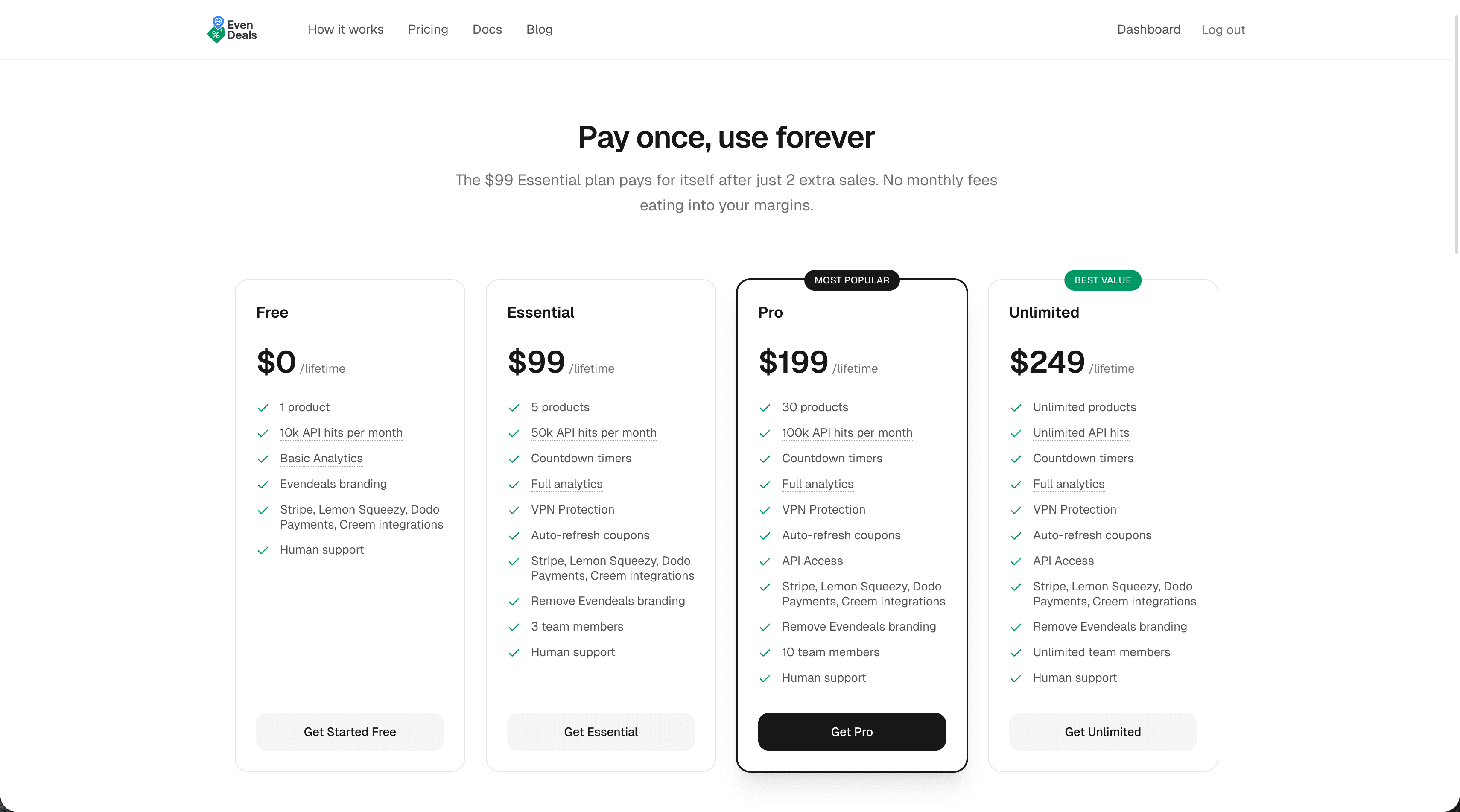
The feature set is similar. The difference is cost structure. If you prefer OpEx-style monthly billing or you're already deeply integrated with ParityDeals' Campaign API, switching may not be worth it. But if you're evaluating from scratch and cost matters, the one-time model saves a significant amount over time.
For a full feature-by-feature comparison, see our ParityDeals Alternative page.
Bottom Line
ParityDeals is a proven tool that works. Their free plan is a solid way to test parity pricing, and the paid plans deliver the features you need for production use — VPN blocking, auto-refreshing coupons, and API access.
The main consideration is cost. At $49-99/month, it's one of the more expensive tools in the parity pricing space, especially since these tools are "set and forget" infrastructure — you configure them once and they run in the background.
Both ParityDeals and alternatives like Evendeals have free plans. The best way to decide is to try both and see which fits your workflow. For a broader tool comparison, see our best pricing tools for SaaS roundup, and if you're ready to set up, follow our country-based pricing guide.
Try Evendeals Free