
How to Price Digital Products Globally: The Complete Guide
A $99 product is a casual purchase in the US. In India, it's 10-15% of a monthly salary. If you sell digital products with a single global price, you're leaving most of the world on the table. This guide covers everything you need to price digital products for a global audience—strategies, data, tools, and a step-by-step framework.
The Problem: One Price Doesn't Fit All Markets
The global digital goods market was valued at $124 billion in 2025 and is projected to reach $511 billion by 2031, growing at 26.6% CAGR. E-books, courses, SaaS, templates, music, games—digital product categories are exploding worldwide.
But most creators and companies still charge a single US-centric price. Research by ProfitWell shows that companies using flat global pricing experience up to 30% lower market penetration in developing economies compared to those using economic adjustment models. That's revenue you're missing from Latin America, Southeast Asia, Africa, and Eastern Europe—regions where internet adoption is growing fastest.
Four Global Pricing Strategies
1. Flat Global Pricing
One price everywhere. Simple to manage, but you lose price-sensitive markets entirely. Works only if your audience is concentrated in high-income countries.
- Pros: Zero overhead, easy to communicate.
- Cons: Excludes 80%+ of the world's population. Competitors who localize will take those markets.
2. Regional / Tiered Pricing
Group countries into 3-5 tiers based on income level and set a different price for each tier. Netflix, Spotify, and most SaaS companies use this approach. Netflix's premium plan, for example, costs $22.99/month in the US but roughly $4/month in Turkey.
- Pros: Manageable complexity, significant lift in emerging-market revenue.
- Cons: Requires maintaining multiple price points; still leaves money on the table within each tier.
3. PPP-Based Pricing (Purchasing Power Parity)
Adjust prices based on the actual cost of living in each country. The Big Mac Index illustrates the concept: a Big Mac costs $6.98 in Switzerland but $2.55 in India—a 2.7x difference that currency conversion alone doesn't explain. PPP pricing applies this principle to your product.
A course creator might charge $50 in Denmark, $25 in Romania, and $5 in Liberia—each price reflecting roughly the same share of local purchasing power. Stripe reported a 45% increase in emerging-market customer acquisition after implementing regional adjustments.
- Pros: Maximizes accessibility, feels fair to buyers, can dramatically increase global volume.
- Cons: Needs tooling to automate; requires VPN protection so high-income users don't game discounts.
Deep dive: Why Your Online Business Needs Parity Pricing.
4. Freemium / Free Tier
Offer a free version with limited features and charge for upgrades. Particularly effective in emerging markets where any price is a barrier to initial adoption. Spotify, Canva, and Notion use this to build massive user bases globally, then monetize through premium upgrades.
- Pros: Removes the price barrier entirely for entry; builds brand awareness.
- Cons: Requires high volume to work; conversion to paid can be low (typically 2-5%).
How to Research Local Pricing
Use PPP Data
The World Bank publishes PPP conversion factors for every country. A PPP ratio tells you how many local currency units buy the same basket of goods that $1 buys in the US. Evendeals provides a free PPP API that returns a recommended discount percentage for any country, saving you from doing the math yourself.
Competitor Analysis
Check what competitors charge in your target markets. Use a VPN to view pricing pages from different countries, or search "[product category] pricing [country]" to find local competitors. Pay attention to the price-to-income ratio, not just the absolute number.
Customer Surveys
Ask your international audience directly. Tools like Typeform or Google Forms with a "what would you pay?" question, segmented by country, give you first-party data. Even a simple willingness-to-pay survey with 50-100 responses per market can validate your pricing tiers.
Payment Methods by Region
Pricing is only half the battle. If customers can't pay with their preferred method, they won't convert. Regional preferences vary dramatically:
- India: UPI handles 55% of online sales. Credit cards are growing (23% CAGR through 2028) but UPI is the default.
- Brazil: Pix overtook cards in 2025, now handling 42% of e-commerce value, projected to reach 50% by 2028.
- Africa: Mobile money dominates. M-PESA accounts for 48% of Kenya's e-commerce and is expanding across Tanzania, Mozambique, Ghana, and more.
- Europe: Card-dominant, but iDEAL (Netherlands), Bancontact (Belgium), and SEPA direct debit are important locally.
- Southeast Asia: GrabPay, GCash, ShopeePay, and bank transfers are widespread. E-commerce spending is outpacing other emerging markets.
Globally, digital wallets accounted for over 53% of online payments in 2024. If you only accept Visa/Mastercard, you're already losing customers in high-growth regions.
Tax and Compliance Basics
Selling digital products internationally means navigating VAT/GST in 110+ countries. Key facts:
- EU: VAT ranges from 17% (Luxembourg) to 27% (Hungary). The One Stop Shop (OSS) system lets you file VAT across all EU countries through a single portal.
- India: 18% GST on digital goods.
- Australia: 10% GST.
- Japan: 10% consumption tax.
- US: No federal digital goods tax, but state-level sales tax varies.
Practical advice: Use a Merchant of Record (MoR) service like Paddle, Lemon Squeezy, or Dodo Payments if you want to avoid handling tax remittance yourself. They collect and remit VAT/GST on your behalf. If you use Stripe directly, pair it with a tax automation tool like Anrok or Quaderno.
Tools for Implementation
You don't need to build everything from scratch. Here's the stack most global sellers use (for a deeper comparison, see our best pricing tools for SaaS roundup):
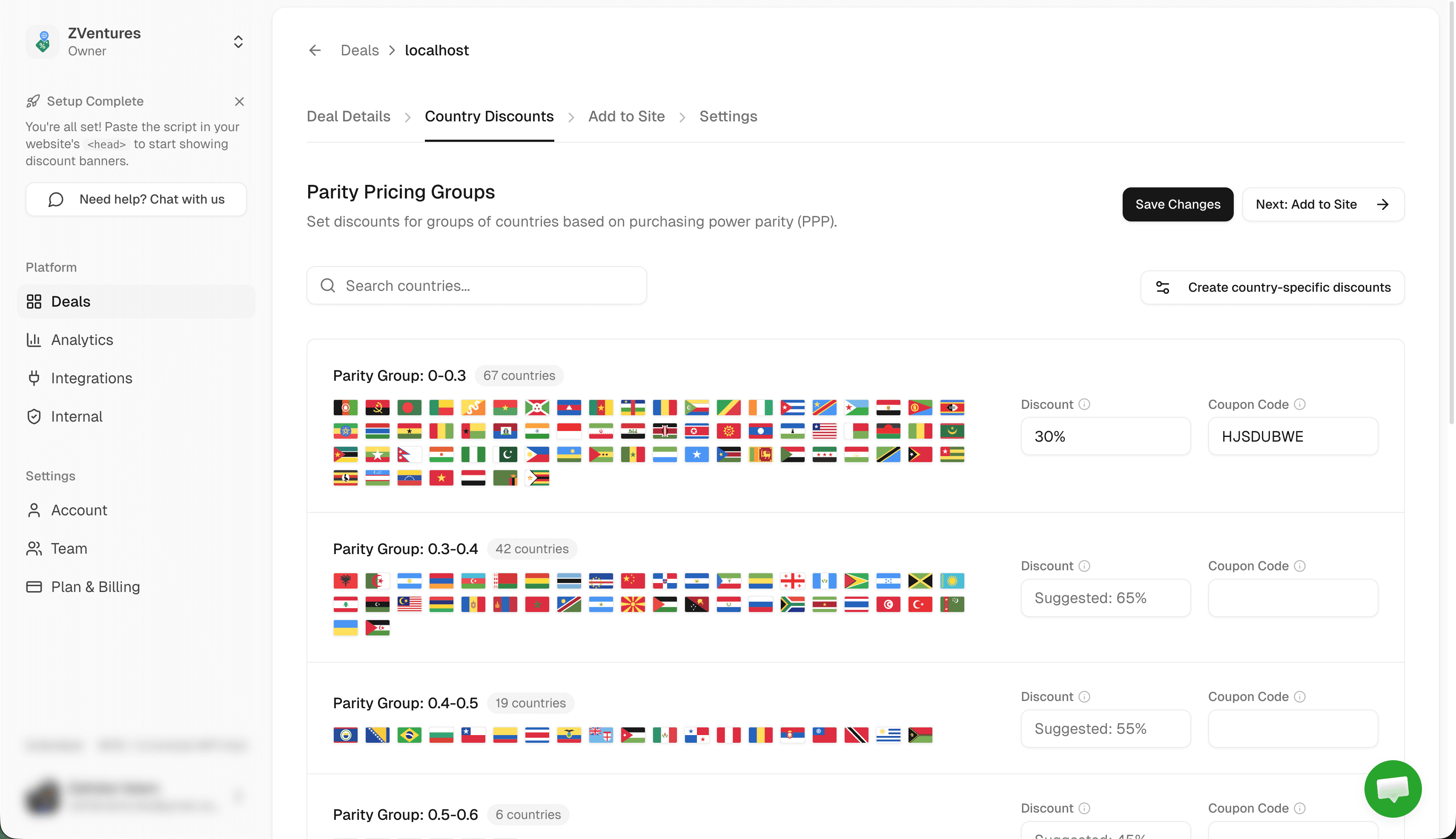
- Evendeals — Adds PPP-based pricing to any website in minutes. Detects visitor location, shows country-specific discount banners, and auto-syncs coupon codes with Stripe, Lemon Squeezy, Dodo Payments, Creem, Polar, WooCommerce, or FastSpring. Includes VPN detection on paid plans. See the setup guide.
- Stripe — Multi-currency checkout with 135+ currencies. Supports local payment methods (UPI, Pix, SEPA, and more). Pair with Evendeals for automatic coupon creation by country.
- Paddle / Lemon Squeezy — Merchant of Record services that handle tax collection, VAT compliance, and multi-currency billing.
- Dodo Payments — Payment infrastructure built for global selling, especially strong in emerging markets. Integrates with Evendeals for PPP coupon sync.
- Anrok / Quaderno — Tax automation for digital goods if you handle payments directly.
Case Studies: Companies Getting Global Pricing Right
Netflix — Regional Tiered Pricing
Netflix prices its plans differently in every market. The Premium plan costs ~$23/month in the US but ~$4/month in Turkey and ~$7/month in India. This isn't charity—it's strategy. India is now one of Netflix's fastest-growing markets by subscriber count.
Spotify — Market-Specific Tiers
Spotify Premium ranges from ~$1.59/month in India to ~$12.99/month in the US. In markets where even $1.59 is steep, the free ad-supported tier builds habit and brand loyalty that converts later.
OpenAI — ChatGPT Go in India
OpenAI launched ChatGPT Go at ~$4.50/month in India, roughly 60% cheaper than the US Plus plan. This is a textbook PPP move—pricing for the local market while protecting margins in higher-income regions.
Stripe — Regional Pricing for Acquisition
Stripe itself saw a 45% increase in customer acquisition in emerging markets after implementing economically adjusted pricing—proving that even B2B infrastructure companies benefit from localization.
Step-by-Step Framework: Price Your Digital Product Globally
Here's a practical framework you can follow today:
- Audit your traffic. Check Google Analytics for your top 10-20 countries by visitors. Focus on countries with high traffic but low conversion—these are your price-sensitive markets.
- Get PPP data. Use the Evendeals PPP API or World Bank data to determine the purchasing power ratio for each country relative to the US.
- Group countries into tiers. Create 3-5 tiers. Example: Tier 1 (US, UK, Nordics) = full price. Tier 2 (Southern Europe, Japan) = 15% discount. Tier 3 (Brazil, Mexico, Turkey) = 30% discount. Tier 4 (India, Southeast Asia, Africa) = 50% discount.
- Set a price floor. Calculate your minimum viable price—the lowest you can go while still covering costs and keeping the product sustainable. Never go below this.
- Choose your mechanism. Auto-applied coupons (easiest with Evendeals), separate pricing pages by region, or dynamic checkout pricing via API.
- Support local payment methods. At minimum, enable UPI (India), Pix (Brazil), and mobile money (Africa) if those are key markets. Stripe supports most of these natively.
- Handle taxes. Use a Merchant of Record, or integrate tax automation. Don't ignore this—penalties are real and growing.
- Protect against abuse. Enable VPN detection to prevent discount gaming. Evendeals includes this on paid plans. Requiring a local payment method (e.g., Indian credit card) is another effective safeguard.
- Monitor and iterate. Track conversion rates by country. A/B test discount levels. ProfitWell found that a 1% improvement in monetization can lift revenue by ~15%—small pricing tweaks compound fast.
Common Mistakes to Avoid
- Setting discounts too high. A 90% discount devalues your product and attracts VPN abuse. Stay within PPP-justified ranges (typically 15-60%). The evidence shows that even moderate discounts significantly increase sales.
- Ignoring VPN fraud. Without detection, a significant percentage of "emerging market" purchases come from VPN users in high-income countries.
- Forgetting about taxes. Over 110 countries now require VAT/GST on digital goods from foreign sellers.
- Only localizing price, not currency. Showing "$25" in USD to someone in Brazil is friction. Show R$125 instead.
- Not testing. Launch regional pricing as an experiment. Measure for 30-60 days before committing. If you're not sure what's going wrong, read why you're losing international sales.
The Bottom Line
The global digital products market is growing at 26%+ annually, but most of that growth is happening outside North America and Western Europe. If you charge one price worldwide, you're optimizing for a fraction of your potential market.
PPP-based pricing isn't about charging less—it's about charging appropriately for each market. Companies like Netflix, Spotify, and Stripe have proven this at scale. With tools like Evendeals, you can implement the same strategy in minutes, not months.
Start with your analytics, identify your price-sensitive markets, and run a 30-day test. The data will speak for itself.
Further Reading
- Country-Based Pricing: The Ultimate Guide
- Why Your Online Business Needs Parity Pricing
- Purchasing Power Parity API
- How AI Companies Use Regional Pricing
- ChatGPT Go in India: A PPP Case Study
Sources
- Mordor Intelligence — Digital Goods Market Size & Growth Report
- ScaleMath — Parity Pricing for SaaS Startups (ProfitWell data)
- Dodo Payments — How PPP Pricing Can Unlock New Markets
- PCMI — Top Global Payment Methods 2025
- EBANX — UPI and Pix Payment Trends 2025
- GR4VY — 112 Payment Industry Statistics
- Fonoa — VAT & GST on Digital Services: 110+ Countries
- SurgeGrowth — Understanding PPP for Global Pricing