
Why You're Losing International Sales (And How to Fix It)
Your analytics show international traffic but near-zero conversions. Visitors from India, Brazil, Nigeria, and dozens of other countries land on your site, browse your product, and leave without buying. Here's why — and what to do about it.
The Pricing Gap Nobody Talks About
Let's start with a number that explains everything: $99.
In the United States, with a GDP per capita of roughly $85,000, a $99 product represents about 0.1% of annual income. Affordable. Reasonable. An impulse buy for many.
Now look at what $99 means in other countries:
- India (GDP per capita ~$2,900): $99 is about 3.4% of annual income — equivalent to a US customer paying roughly $2,900 for the same product.
- Brazil (GDP per capita ~$10,300): $99 feels like $820 to a US buyer.
- Nigeria (GDP per capita ~$1,600): $99 is 6.2% of annual income — equivalent to a US customer paying $5,200.
Would you pay $5,200 for an online course? Neither would they. The product isn't the problem. The price, relative to local income, is the problem.
Sources: World Bank GDP per capita data (2025), Worldometer GDP per capita
Cart Abandonment by Region: The Hard Data
Global cart abandonment already averages 70% (Baymard Institute, 2026). But the regional breakdown tells a much more painful story:
- Middle East & Africa: 93% abandonment rate
- Asia Pacific: 87% abandonment rate
- Latin America: 87% abandonment rate
- Nordics: 80% abandonment rate
- North America: ~70% abandonment rate
That's a 23-percentage-point gap between North America and Africa/Asia. For every 100 visitors who add your product to cart, 93 leave without paying in the Middle East and Africa — versus 70 in the US. The gap isn't about intent. It's about affordability and friction.
Sources: Email Vendor Selection (2026), Growth Suite (2026)
The “Invisible Wall”
Cart abandonment only measures people who made it to the cart. The bigger problem? Visitors who see your price, mentally convert it to their local currency, and close the tab before they even click “Buy.”
These visitors never show up in your cart abandonment data. They're invisible. Your analytics might show a 2-second session from Mumbai or a bounce from Lagos — but you'll never know they wanted to buy and simply couldn't justify the price.
Ecommerce conversion rates confirm this. Mature markets like the US and UK convert at 2-4%. Emerging markets in Africa, Latin America, and Southeast Asia? Below 1-2% (Smart Insights, 2025). That's not a product problem. It's a pricing and infrastructure problem.
5 Reasons You're Losing International Sales
1. Prices Too High Relative to Local Income
This is the biggest one. As we showed above, a $99 product can represent days or weeks of income in many countries. No amount of marketing copy fixes a price that's structurally unaffordable. The product could be life-changing and they still won't buy it — because they literally can't.
2. No Local Payment Methods
Credit card penetration varies wildly by country. In India, only about 7% of the population has a credit card. In Brazil, Boleto Bancario and PIX dominate. In Nigeria, bank transfers are standard. If your checkout only accepts Visa and Mastercard, you're excluding the majority of potential buyers in these markets.
3. No Local Currency Display
Showing prices in USD creates immediate friction. Visitors have to mentally convert, wonder about exchange rate fees, and feel like the product “isn't for them.” Studies show that displaying prices in local currency increases conversion by up to 40% in some markets.
4. Perceived Value Gap (Digital) / Shipping Costs (Physical)
For physical products, international shipping can double the effective price. For digital products, the problem is different but equally real: a $99 course priced for US buyers feels disproportionately expensive when local alternatives (even lower quality ones) exist for a fraction of the cost. The perceived value doesn't match the price in local economic context.
5. Trust Issues
No local language support. No reviews from people in their country. No local customer stories. Payment pages that don't feel familiar. These friction points compound — a visitor from Indonesia seeing a US-only site with USD prices, English-only content, and no recognizable trust signals will hesitate even if the price were affordable.
The Solution for Digital Products: Parity Pricing
Here's the good news: if you sell digital products (courses, SaaS, templates, ebooks, memberships), you have zero marginal cost per additional sale. The economics of digital products mean that any sale at a reduced price is pure profit you weren't getting before.
Purchasing power parity (PPP) pricing — also called parity pricing — adjusts your price based on the visitor's country and local economic conditions. Someone in India might see a 60% discount. Someone in Brazil, 30%. Someone in the US sees your full price.
This is the same strategy used by Netflix, Spotify, Apple, and every major tech company. Spotify charges $1.59/month in India vs $12.99 in the US. The result? 92.6% revenue growth in India (Monetizely).
How Much Revenue Are You Leaving on the Table?
Let's do some rough math.
Say you get 10,000 monthly visitors and 40% are international (a typical split for English-language digital products). That's 4,000 international visitors per month.
Without parity pricing, your international conversion rate is likely under 0.5% — maybe 20 sales at $99 = $1,980/month.
With parity pricing and an average 40% discount for lower-income countries, even a modest conversion rate increase to 1.5% yields 60 sales at ~$59 average = $3,540/month. That's $1,560 more per month — nearly $19,000 per year in revenue from customers you were getting zero dollars from before.
Research backs this up: a 1% improvement in monetization can lift revenue by about 15% (ScaleMath). Companies that revise pricing quarterly see 4x better ARPU growth over five years compared to annual adjusters.
Real Example: Dave Foy's 30% Revenue Boost
Dave Foy, an online course creator, implemented parity pricing and reported that 30% of his revenue came from parity-priced purchases. Every single one of those sales came from countries where he had never made a sale in eight years of selling courses online.
Not a single sale in eight years. Then parity pricing turned those zero-revenue countries into 30% of his total income. These weren't sales stolen from full-price customers — they were entirely new customers in entirely new markets.
Quick Win: Implement PPP Pricing Today
You don't need to rebuild your pricing infrastructure. With a parity pricing tool, you can start capturing international revenue in minutes:
- Add a small script to your website that detects visitor location.
- Configure discount tiers by country group (e.g., 20% for Brazil, 40% for India, 60% for Nigeria).
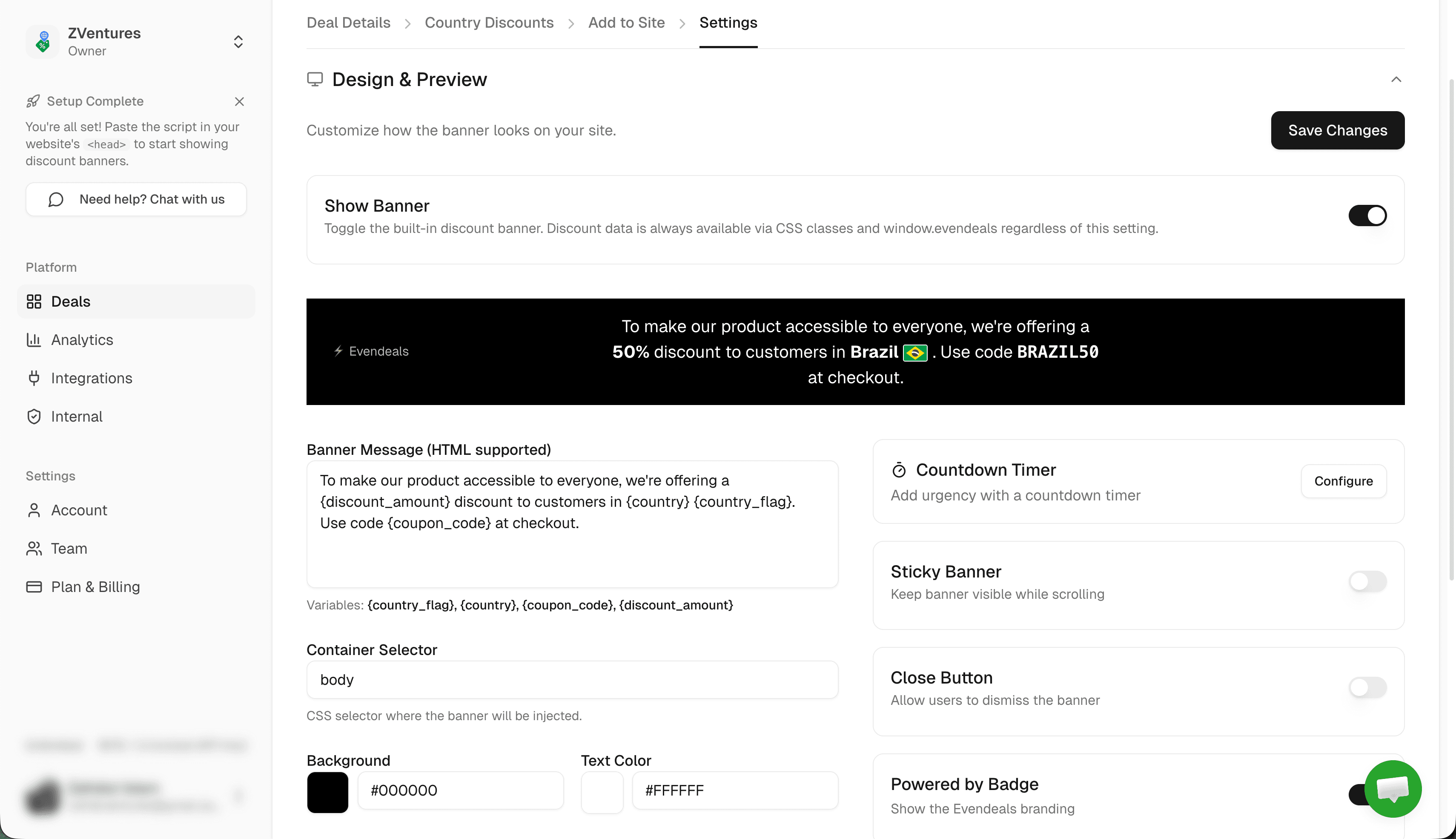
- Show a localized discount banner to international visitors.
- Coupon codes auto-apply at checkout — no manual work needed.
For a full walkthrough, see our Country-Based Pricing: The Ultimate Guide.
But Won't People Abuse Discounts with VPNs?
Valid concern. The answer: VPN detection. Tools like Evendeals automatically detect and block VPN users on paid plans, so only genuine visitors from lower-income countries receive discounts. This protects your US/EU pricing while opening up new markets.
The Bottom Line
You're already paying for international traffic — through SEO, content marketing, social media, and word of mouth. Every visitor from India or Brazil who bounces because of price is a wasted acquisition cost. Parity pricing converts those visitors into paying customers at margins that still make you money.
The math is simple: a discounted sale beats a lost sale. And for digital products with zero marginal cost, there's no downside. Ready for a complete global pricing framework? Read how to price digital products globally.
Stop leaving international revenue on the table. Try Evendeals free and start converting global traffic into paying customers.
Try Evendeals Free