
How to Sell Your Online Course Internationally
The global online education market is worth over $100 billion in 2026 and growing at 22%+ annually (source). Most of that growth is coming from Asia, Africa, and Latin America. Yet most course creators price exclusively for US and European wallets — and lose the majority of the world's potential students before they even reach the checkout page.
If you sell online courses, this guide will show you exactly how to price for international students — without devaluing your course or cannibalizing your core market.
The Problem: One Price Doesn't Fit the World
A $199 course feels reasonable to someone earning $5,000/month in the US. But here's what that same price looks like in the rest of the world:
| Country | Avg. Monthly Salary (USD) | $199 as % of Monthly Income |
|---|---|---|
| United States | ~$5,000 | 4% |
| India | ~$400 | 50% |
| Brazil | ~$600 | 33% |
| Philippines | ~$350 | 57% |
| Nigeria | ~$50 | 398% |
| Mexico | ~$700 | 28% |
| Indonesia | ~$300 | 66% |
A Nigerian student would need to save 4 months of salary to buy your course. That student isn't choosing between your course and a competitor — they're choosing between your course and groceries. You haven't lost to a competitor. You've lost to economics.
Why This Matters for Your Business
Over 80% of internet users live outside the US and Western Europe. India alone produces more English-speaking internet users than the US. Brazil, the Philippines, Indonesia, and Nigeria are among the fastest-growing markets for online learning.
These aren't hypothetical students. They're landing on your sales page right now, seeing the price, and leaving. With the right pricing strategy, many of them would buy — and the marginal cost of serving one more digital student is essentially zero.
4 Pricing Strategies for International Students
1. Flat Pricing with PPP Discounts (Recommended — Easiest)
Keep your standard price for the US/EU, but show purchasing power parity (PPP) discounts to visitors from lower-income countries. A visitor from India sees a banner: "Special pricing for India — use code INDIA50 for 50% off."
Why this works best for most creators:
- One price on your sales page — no confusion, no "which tier am I?"
- Discounts are shown only to qualifying visitors via location-based banners
- Easy to set up with tools like Evendeals — no code changes needed
- Works with any course platform: Teachable, Thinkific, Kajabi, Podia, EzyCourse, LearnWorlds
Suggested discount ranges by region:
- 0–15% off: Western Europe, Australia, Canada, Japan
- 20–35% off: Eastern Europe, Mexico, Brazil, Argentina, Turkey
- 40–60% off: India, Southeast Asia, Egypt
- 60–75% off: Sub-Saharan Africa, Bangladesh, Pakistan
2. Tiered Pricing (Different Price Points by Region)
Instead of one price plus discounts, you create distinct pricing tiers for different regions:
- Tier 1 ($199): US, UK, Canada, Australia, Western Europe
- Tier 2 ($99): Eastern Europe, Latin America, Middle East
- Tier 3 ($49): India, Southeast Asia, Africa
This is what Spotify and Netflix do globally. It works well but requires more setup — you need separate checkout links or pricing pages per tier. Most course platforms don't natively support this, which is why PPP discounts (Strategy 1) are usually easier.
3. Scholarship / Financial Aid Model
Let students apply for a reduced price. Coursera pioneered this: their financial aid program lets any learner apply for free access to paid courses by describing their financial situation. Approval is based on individual circumstances, not geography alone.
Pros: Very targeted — only students who genuinely need it get the discount. Builds goodwill and community.
Cons: Manual review doesn't scale. Many students won't apply — the friction of writing an application essay kills conversions. Better suited for large platforms than individual course creators.
4. Free + Premium Model
Give the core content away free, charge for extras: certificates, coaching, community access, templates, or personalized feedback.
This model works well for audience building and lead generation, but it's hard to monetize at scale unless you have a very large audience. Most independent course creators earn more with paid courses + regional discounts than with free courses + upsells.
How the Big Platforms Handle International Pricing
Udemy: Aggressive Regional Pricing
Udemy uses a country-specific price tier matrix that goes far beyond simple currency conversion. Prices are adjusted based on local market conditions, purchasing power, and competition. A $100 course in the US might be $10–15 in India. The tradeoff: instructors get lower per-sale revenue but access to a massive global audience.
Coursera: Financial Aid Program
Coursera offers financial aid for individual courses and specializations. Learners apply by describing their income and why they need assistance. There are no geographic restrictions — it's evaluated on a case-by-case basis. Aid is valid for 180 days after approval.
Skillshare: One Global Price
Skillshare charges one monthly subscription worldwide. No regional adjustments. This simplicity comes at a cost — their penetration in lower-income markets is significantly lower than Udemy's. It's a cautionary example of how flat global pricing limits growth.
Step-by-Step: Implement PPP Pricing for Your Online Course
The fastest way to add international pricing to your course — no matter what platform you use — is with location-based discount banners. Here's how:
Step 1: Decide Your Discount Tiers
Use the World Bank PPP data as a starting point, then simplify into 3–5 country groups. You don't need per-country precision — grouping by region works well enough.
Step 2: Create Coupon Codes
In your course platform (Teachable, Thinkific, Kajabi, etc.), create coupon codes for each discount tier. For example: PPP20, PPP40, PPP60. If you use Stripe, Lemon Squeezy, Dodo Payments, Creem, Polar, WooCommerce, or FastSpring, Evendeals can auto-create and sync these codes for you.
Step 3: Set Up Evendeals
- Sign up at evendeals.com (free plan available).
- Create a new deal and add your course page URL.
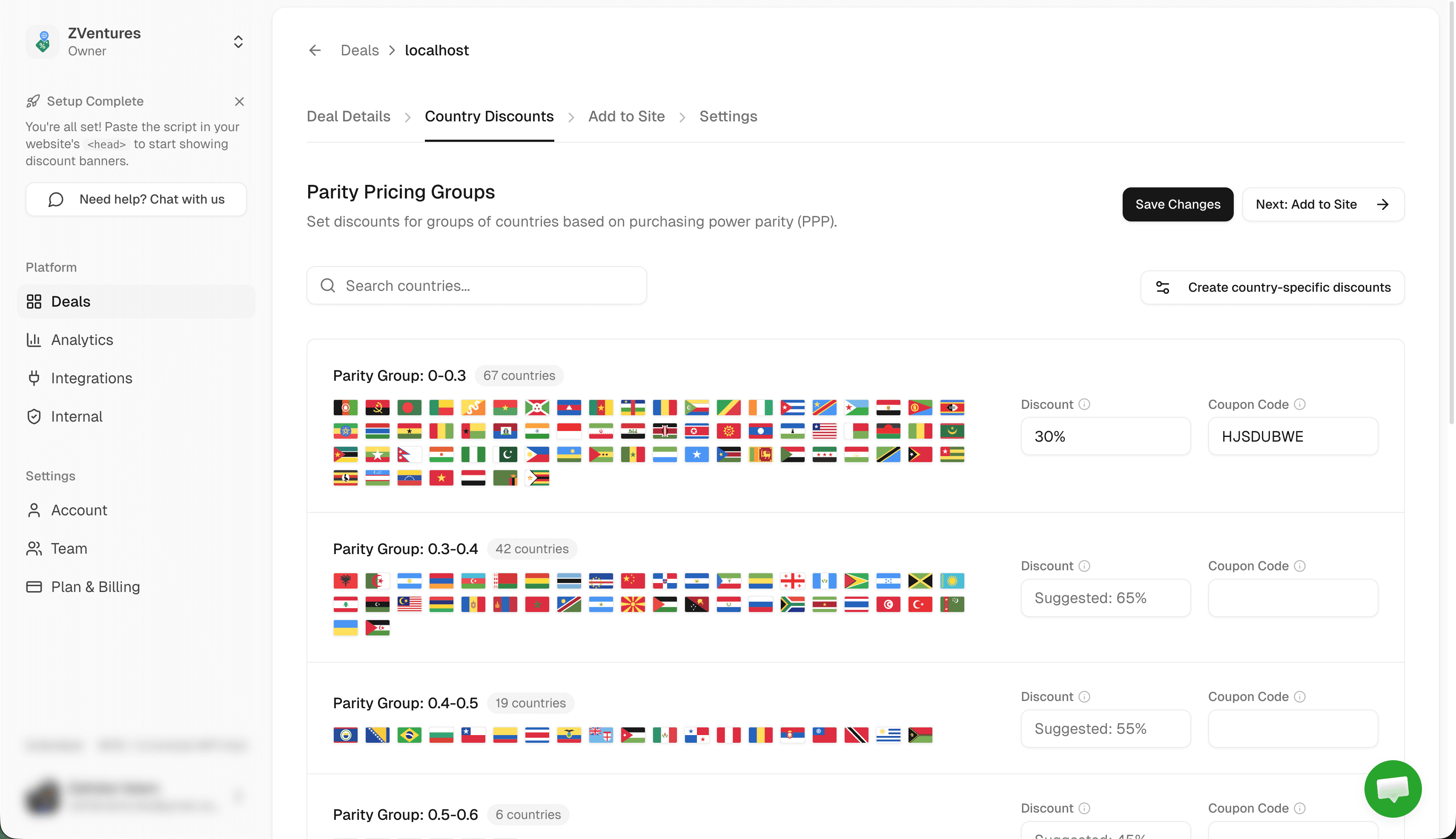
- Map each country group to its discount percentage and coupon code.
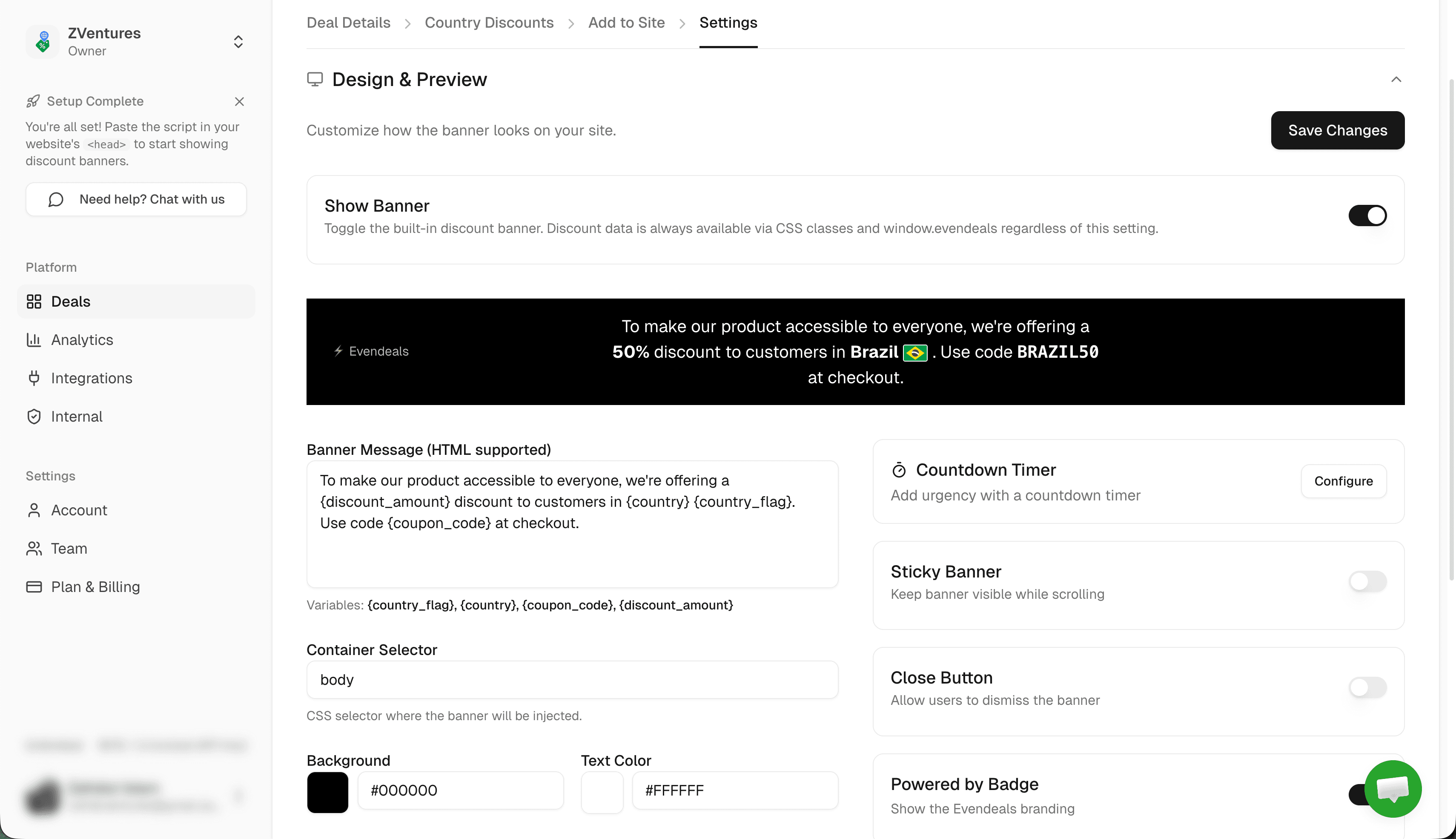
- Customize the banner to match your site's design.
- Copy the one-line script and paste it into your site's header.
Step 4: Test It
Use a VPN or Evendeals' preview mode to see the banner from different countries. Verify the coupon codes work at checkout.
Platform-Specific Guides
We have step-by-step guides for every major course platform:
The Business Case: More Students at Lower Prices Wins
The evidence is clear — parity pricing consistently increases sales across every category of digital product.
Let's do the math. Say you sell a course for $199 and get 100 students/month, all from the US. That's $19,900/month.
Now imagine you add PPP pricing. Your US sales stay the same (US visitors never see the discount). But you pick up:
- 40 students from India at $79 (60% off) = $3,160
- 25 students from Brazil at $129 (35% off) = $3,225
- 20 students from Southeast Asia at $99 (50% off) = $1,980
- 15 students from Africa at $49 (75% off) = $735
That's an extra $9,100/month — a 46% revenue increase — from students who would have paid you $0 otherwise. Your cost to serve them? Essentially zero. Digital products have near-zero marginal cost.
Course creator Max van Collenburg documented his PPP experiment and saw international purchases from countries like Brazil within the first month. The Data School openly offers location-based pricing and reports it as one of their best decisions for reaching a global audience.
FAQ
"Won't US students feel cheated if they find out others pay less?"
In practice, no. Airlines, hotels, and SaaS companies have done this for decades. The key is transparency: you're not hiding a price — you're adjusting for purchasing power. A $79 course in India is proportionally more expensive to that student than $199 is to someone in the US. Most people understand this intuitively. And since the discount banners only appear to visitors from qualifying countries, US students typically don't see lower prices unless they go looking.
"How do I prevent abuse? Won't people use VPNs to get cheaper prices?"
Some will try. In practice, VPN abuse is a small fraction of total sales and the extra revenue from genuine international students far outweighs it. That said, Evendeals (paid plans) includes VPN detection that automatically blocks users faking their location. You can also use auto-refresh (rotating coupon codes) to prevent code sharing.
"What discount percentages should I use?"
Start with World Bank PPP data as a baseline. A reasonable rule of thumb:
- Tier 1 (0–15% off): Countries with GDP per capita above $30,000 — minimal or no discount
- Tier 2 (20–40% off): GDP per capita $10,000–$30,000 (Eastern Europe, Latin America, Turkey)
- Tier 3 (40–60% off): GDP per capita $3,000–$10,000 (India, Philippines, Egypt, Indonesia)
- Tier 4 (60–75% off): GDP per capita below $3,000 (Nigeria, Bangladesh, Pakistan)
Don't overthink precision. Even a roughly correct discount converts far better than no discount at all.
"Should I discount my premium/coaching tier too?"
Usually no. PPP pricing works best for self-paced digital courses where your marginal cost is near zero. For offers that include your time (1-on-1 coaching, live calls), your time has the same cost regardless of the student's location. Offer PPP on the course, keep coaching at a global rate.
"Does this work for subscription-based courses?"
Yes. Apply the same discount to your monthly or annual subscription. A student paying $9/month in India is better than a student paying $0/month. Recurring revenue from international students compounds over time.
Start Selling Globally Today
You've built a great course. Don't let arbitrary geography decide who gets to learn from it. PPP pricing takes 5 minutes to set up, costs nothing to start, and unlocks revenue from the 80% of the world you're currently ignoring.
Evendeals handles the hard part — detecting visitor location, showing the right discount, generating coupon codes, and blocking VPN abuse. Free plan available, paid plans start at $99 one-time.
Try Evendeals Free