
How to test regional pricing when your traffic is small
Three people used your regional coupon this week. Last week, nobody bought from those countries. It's tempting to call that proof.
It's a useful signal. It isn't enough to tell you what caused the change or whether the offer will keep working. A small test can still help, as long as you ask a question your data can answer.
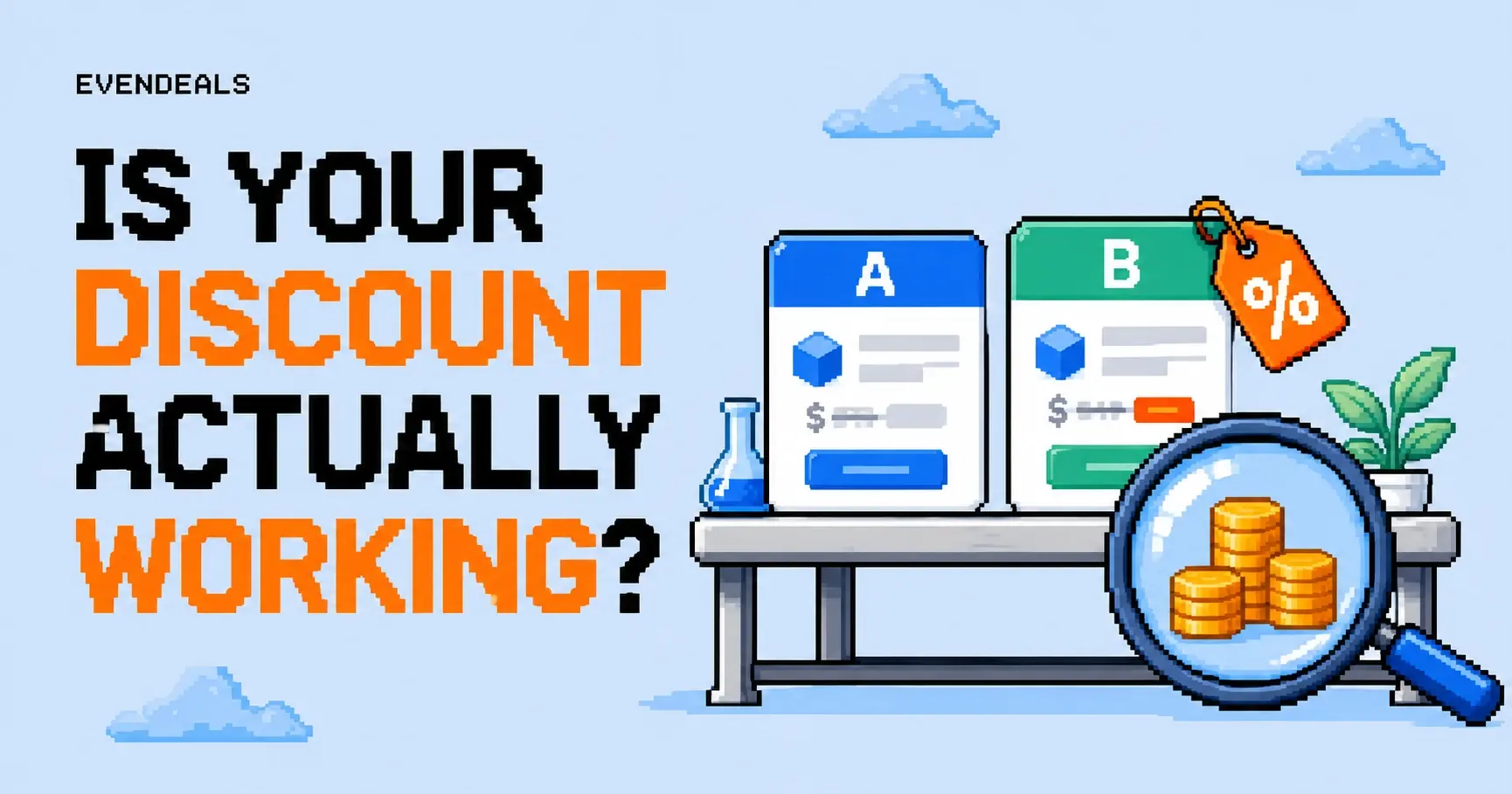
Write the question before launching
Try something specific: will a 30% discount increase contribution per eligible pricing-page visitor for this course? The percentage and product are examples. Choose a price that fits your own costs.
That question names the offer, audience, and outcome. Compare it with asking whether PPP works. The broad version doesn't tell you what to measure or when to make a decision.
Record the eligible countries, product, billing period, start date, and traffic sources. Write down the current checkout behavior too. If the coupon field is hidden or broken, you're about to test that problem along with your price.
Choose an honest comparison
If you can randomly split eligible visitors between offers, you get a cleaner comparison. Keep a visitor in the same group across visits, document assignment, and avoid switching their price mid-checkout. Building that experiment may require work in your site or analytics setup.
Evendeals manages regional offers and their display. Don't assume enabling a deal creates a randomized experiment or calculates statistical significance for you.
If you can't randomize, compare a baseline period with an offer period and describe the result as observational. Record promotions, traffic changes, holidays, and product updates. Those can explain a change that the discount gets credit for.
Keep the periods comparable where possible. Seven days that include a launch email aren't equivalent to seven quiet days just because the date ranges are the same length.
One offer, one comparison, one decision
Before the test
Save the eligible audience, normal price, costs, and current conversion rate.
During the test
Keep the offer stable. Record who saw it, who paid, and what each order earned.
At the review
Compare money left per eligible visitor. Keep, adjust, or continue gathering evidence.
Track a short purchase funnel
Collect enough information to tell whether customers saw and used the offer. Use your existing analytics and payment records, with the privacy settings appropriate for your site.
- Eligible pricing-page visitors, using one consistent counting rule.
- Visitors shown the offer and visitors who started checkout.
- Completed paid orders, discount amount, and eligible product.
- Refunds, fees, and variable costs over a consistent follow-up window.
Coupon copies are useful for diagnosing the page. They aren't sales. A copied code can be abandoned, shared, or rejected at checkout.
Give each offer a stable internal label so you can join the records. If you rotate coupon codes, keep a mapping between codes and the offer. Otherwise one experiment can look like several unrelated campaigns.
Compare rates and amounts together
Here's a hypothetical result. A baseline has 500 eligible visitors, 10 paid orders, and $700 contribution after variable costs. The offer has 500 eligible visitors, 15 orders, and $510 contribution.
Conversion rose from 2% to 3%. Contribution per visitor fell from $1.40 to $1.02. That offer brought more customers but left less money per visitor under the example's assumptions.
The numbers don't establish statistical significance. They show why conversion alone can't decide the outcome. Also inspect refund rate, support load, and whether the traffic mix changed.
Decide what you'll do with an unclear result
There isn't a universal minimum sample size for every pricing test. It depends on your baseline, the difference you need to detect, and the analysis you choose. Picking an arbitrary 100 visitors doesn't fix uncertainty.
For low traffic, set a review date and a budget for how much discounting you're willing to fund while learning. The review date is when you check in. It doesn't make a small sample reliable.
If the result is unclear, keep the conclusion narrow. You might have verified that the coupon works and customers understand it, while still not knowing its effect on revenue. That is progress.
Stop early for broken checkout, misleading amounts, or a contribution loss you can't sustain. For ordinary performance fluctuations, avoid changing the discount every day. You need a stable offer to learn anything useful.
What a useful first week looks like
You launch the offer on Monday. By Friday, 40 eligible people have visited and two have paid. The tempting move is to double the discount and see whether next week looks better. I'd leave it alone long enough to understand what happened first.
Check those two payment records. Did the right product get the right discount? Did the customers receive access? Then look at where the other visitors stopped, using the tracking you actually have. If several people copied the code but nobody started checkout, test the path between those steps.
If you already have permission to contact buyers, ask one simple question about the buying experience. Don't turn the reply into a testimonial without consent. Their feedback is useful because it can explain a confusing step, not because two happy customers prove the price is right.
Keep your notes separate: things you verified, things you suspect, and things you still need more orders to judge. That stops a quiet week from becoming an excuse to change everything. The test can be useful before it can be conclusive.
Leave a record for the next test
Save the setup, counts, net receipts, costs, and decision. Add a sentence about what you still don't know. If you change the offer, start a new version rather than mixing the results.
For implementation, follow the Evendeals quick start. For the volume you need to protect contribution, use the regional pricing margin calculation. Then test one decision at a time.
Write down the decision you want to make, then set up one offer. Keep it steady, check the payments, and give yourself permission to say you don't know yet. That's how the next test gets better.